Pages

Friday, February 14, 2014

February: Fun Dip or Flowers?

The way you answer that question solely depends on whether or not you teach elementary school.  I’ve said it before and I’ll say it again: there is no more trying holiday for a teacher than Valentine’s Day.  If you teach elementary school, there is too much candy.  If you teach middle school, there is too much drama.  And if you teach high school, I don’t even want to think about what there is too much of... 

For an elementary teacher, the difference between Valentine’s Day and all the other holidays is that this is the only one where they ALL bring STUFF TO each other.  Back in my day, you simply exchanged cards, the class mom brought in cupcakes, and you called it a day.  Nowadays, there is an explosion of candy hearts, M&Ms, Skittles, little chocolates, plastic rings, temporary tattoos, and Fun Dip (oh, the Fun Dip…) Some years, even in fourth grade, there is a “couple” or two and you can throw in a teddy bear and a box of chocolates.  The kids are so hyped up and the mess is unimaginable.  By the time I survive the day, spending a romantic evening with my husband is out of the question.  It’s usually frozen pizza and a foot rub for me on the evening of February 14th.  If he’s lucky, I’ll feel like a teacher and not a Dollar Tree manager again by the weekend.

The passing out of the goods is such an ordeal that we begin a week before and encourage parents to send in the treats early so they don’t all have to distribute on the same day in total chaos (in this regard, we’ve outsmarted the floral delivery services).  This plan means there are little red and white bags, exploding with 10-year-old Valentine’s Day bliss, lining the whiteboard at the front of my classroom today, unattended and untouched, thanks to the massive snowstorm of 2014.  The surprising thing is that after spending eight years complaining about Valentine’s Day in my classroom, I’m a little sad not to be there today.  While I know this is partly due to the fact that now the Valentine’s Day hoopla will occur on a Monday and not a Friday (oh, the horror…), it’s more than that. 

There is nothing like those little faces when they get their bag of Valentine cards (and other STUFF…).  While you’d think they’d be tearing into the Fun Dip first thing, you’d be surprised.   I’ve yet to see a child who doesn’t sit there and read every single card, from every single classmate.  They smile, they giggle, they raise their eyebrows, they share the best ones with the person who sits beside them, and they simply eat up every word… BEFORE they eat up the three candy items that I allow them to carefully choose before they bag up the rest to take home. 

The whole scene always makes me kind of wish that adults still did Valentine’s Day in a similar way.  Who doesn’t need a word of affirmation from time to time?  A compliment, a laugh, a reminder that you’re needed, wanted, even noticed at all… It all matters, it all helps, it all brings a smile to their faces and a little comfort to their hearts.   And isn’t that what Valentine’s Day is all about?  Letting someone else know they matter to you? I’m sure most of the kids in my class will have already heard “Happy Valentine’s Day” from their parents, the way most of us have already heard it from our significant others today, but what about the other people in your life?   Bring a smile to someone’s face and a little comfort to their heart, and tell them they matter, you notice, and your heart would be a little (or a lot) emptier without them. 


I’ll miss being in my classroom today because it’s the day that it’s most clear to me that we all need each other, every single day, not just on this one day that we “celebrate” love.  It’ll be nice to prove to my kids next week that it doesn’t have to be February 14th for us to share a little love with each other.  In fact, I think I’ll tell them we should try it more often.


Thursday, February 6, 2014

Math Centers: A Three Ring Circus

I’ve always said teaching math is like running a three-ring circus.  One year, I team taught with a friend and I only taught math; I couldn’t believe how exhausted I was at the end of each day.   During a math block, there is no down time.  Each task you assign requires 10 minutes of student effort at absolute most and one minute on average.  There are constant questions and there is never a moment when less than five students genuinely need your assistance (usually it’s more like ten). 

Furthermore, there is so much pressure to make math fun.  When my students have to actually sit in their seats and take a math quiz on a Friday, I’m literally greeted with groans and comments like, “I thought Fridays were supposed to be fun.”  I don’t think they’ve have even touched their math textbooks this year.  I do pull the electronic version up on the Promethean board from time to time, but if I asked my students to open their textbooks and do some math problems, they wouldn’t even know what I meant.

Teaching math has changed since I was in school for sure— more than any other subject.  I’m reminded of that regularly in parent conferences when perfectly intelligent thirty-somethings tell me they have no idea how to help their child with their math homework.  It’s fast-paced and you have to come at it from so many different angles— ten-year-old brains are wired this way and it’s not a huge problem or the kids; it’s us teachers who sometimes struggle to keep up the pace.

Over the past few years, I’ve gradually changed how I set up my math block, to the point where it now isn’t even recognizable compared to what it looked like when I first started teaching.  Sometimes I think back to the ole daily math practice on the overhead projector, the never-ending stacks of transparencies, the whole group “guided practice,” trying to do a complicated activity with the whole class at once... and shake my head.

While I doubt any of us are still teaching by the blinding light of the overhead projector bulb, I know from talking with my colleagues that math looks different in everyone’s classroom.  Most of us are accustomed to teaching small groups in reading, but for some reason, teaching small group math has been a lot slower to catch on.  The only reason I started trying it was out of desperation one school year when I had 30 students in my math class.  If I could put them into three groups, perhaps I could reach them ten at a time, I thought.  It worked, better than I expected, and I never looked back.  

In essence, math in my classroom IS a three-ring circus.  Four days a week, we operate on a three-center rotation.  I have found that this method not only allows me to engage with every student one-on-one every day to ensure understanding, but it also requires students to work together and think for themselves.  It’s hard to tell what’s going on with test scores these days, but my entire grade level teaches math small groups in one form or another, and we have shown steady growth in math the past few years. 

Each day, we open class with a homework check and an activating strategy of some kind.  After that we do centers for about an hour, hopefully leaving time at the end for a summarizing strategy.  The heart of my math block is the centers, which each last 20 minutes:

Teacher Time: Students meet with me on my carpet area by my Promethean board.  I teach the skill we are currently focusing on, they practice on white boards and do activities with me on the Promethean board.  Many days, we end with an interactive game where each student gets up and gets involved.  With less than ten kids on the carpet with me, I can ensure that each child is fully engaged, and they feel more comfortable approaching me with questions. 


Partner Practice:  Students each have an assigned table where they and an assigned partner sit and work together.  They usually have a game to play, and I have pre-loaded most of the necessary supplies in a small plastic bin.  There is also a folder for each table with standing activities to work on – word problems or a math puzzle activity, for example.  The folders and supply bins are key (including pencils!) because the students have no reason to be wandering around the room looking for supplies.  If they are out of their seat, they off considered off task.  If they have a question, they have to work together to figure it out. 


Skills and Strategies: This center is really two stations in one.  For ten minutes, half the group is on the computer working on an assigned website and the other half is at a large table in the back of my room working on basic math skills (spiral review word problems, math journals, math facts, etc.)  After ten minutes, I give a signal, and the groups switch.  Again, everything the students need is already at the table for them—there is a zero tolerance policy on wandering around the room.


I have found that it works best if you do plan the groups at least somewhat by skill level – if you mix them, you can’t make as much progress with your accelerated learners in Teacher Time, and the kids who need a little more help get left behind. This is perhaps the most important benefit of teaching small group math – students get the same individualized attention as they do in guided reading.  I use a certain template when making up my groups.  It would look like this for a 24 student class:

Student A, Student B
Student C, Student D
Student E, Student F
Student G, Student H

Student I, Student J
Student K, Student L
Student M, Student N
Student O, Student P

Student Q, Student R
Student S, Student T
Student U, Student V
Student W, Student X

Each section would be a group.  I suggest rotating the groups the same way each day so that students are never confused about where to go next.  Student A and Student B are partners, and Students A, C, E, and G would get first turn on the computers, tagging off with their partners after the 10 minutes.  This gives different students the chance to work together during Skills and Strategies than at Partner Practice (and less time for them to get sick of each other and start arguing). 

Speaking of time, keeping a timer is vital!  I use the timer on my phone and if I didn’t, this plan would run off the tracks every single day.  I have a certain sound I ring on a bell at the ten minute switch that’s different than the time when we all switch stations.  The kids know the difference, and they move around the room like soldiers.  Okay, that’s an exaggeration…they still act like crazy ten-year-olds in transition but they DO know where to go and they get there relatively quickly.  That’s also because I have an entirely different discipline plan for math groups than I do for the rest of my day…I want to be able to hand out a consequence with no warning, no parent repercussions, and no apologies, so we have a special reward system just for that hour.

Teaching math in small group doesn’t only help me teach more effectively, it also helps me plan more effortlessly.  Planning math feels more like putting together a puzzle.  Instead of having to fill a seemingly endless hour-and-a-half block with short, little activities, I just have to fill in the blanks for the schedule and routine we keep every single day.  I’ve said many times, “My math pretty much plans itself.” 

Teaching math DOES feel like running a three-ring circus but this plan at least leaves me feeling more like the ringmaster and less like the lion tamer.  If you’re feeling like you’re juggling too many balls during math, it’s definitely worth a try. 

Tuesday, January 28, 2014

Trust

I’ve found that my infertility puts my faith in a precarious position.  I’ve always held the view, deep inside, that every facet of my life is touched by God’s hand.  Don’t get me wrong: I love God and I know He loves me.  That was never in question; in fact, it is a part of what has made this so disconcerting.  From the moment I heard the word “unexplained” come out of the doctor’s mouth, I felt there WAS an explanation: God’s hand. 

Naturally, then comes the question, “Why, God?”  I could write a book on the times I’ve asked this and the variety of answers I’ve imagined He might give.  The “answers” to “why” in my mind and heart have evolved over time, as has my sanity level.  At first, I couldn’t fathom any sensible explanation, but now I can see so many reasons “why,” many of which do make things easier to live with.  But there has been one thought as to “why” that has nagged at me relentlessly: did God decide He couldn’t trust me with this?

I’ve always been the super-responsible, get-it-done and get-it-done-well type.  Assign me the hardest class with a difficult professor and I’ll find a way to ace it.  Put a challenging student in my class and I’ll find a way to tame him (or I’ll at least keep a smile on my face while I try).  Ask me to teach at school all day, then teach at church that night, and I’ll have the lesson plans laid out, ready-to-go and give it my all.  There was no reason to think I couldn’t have two or three kids and keep balancing everything else on my plate…isn’t that what they call “having it all?” 

So, in addition to the heartbreak and confusion of infertility, quite frankly, I was pissed off.  Why would God “trust” seemingly everyone else with children and not entrust me with my own?  What had I done, or not done, to fall out of His favor when it came to motherhood?  Am I too much?  Not enough? Just not quite fit for it? 

Until just recently it hit me.  Perhaps it isn’t that I’m NOT fit for motherhood, but instead that I AM fit for so much else, so many opportunities that I would have overlooked or missed altogether had things gone according to my plan.  What would my life look like had I gotten what I thought I deserved?  I’m by no means discounting how amazing it would have been had it gone that way…but at what cost?  Friends I never would have made, students I never would have taught, a marriage less proven, a faith less tested, a heart untouched by this experience and those it has brought into my life… all in all, a shallower version of myself…

It isn’t that He doesn’t trust me.  It’s that He trusts me with something else, something different, something just as important…the truest version of myself.  He does, in fact, trust me and He expects me to make the most of the life HE has planned for me.  Not the one I had planned for myself.

How often do we really get what we expect?  When it comes to our faith, our relationships, our families, our jobs, our LIVES…do things really ever turn out like we plan?  It’s time that we stopped asking, “Why?” and started asking, “Why not?” and “Where do we go from here?”  …and it’s time that we truly trusted Him with the rest.

From everyone who has been given much, much will be demanded; and from the one who has been entrusted with much, much more will be asked.”  -Luke 12:48

Saturday, January 25, 2014

Calling All Teachers

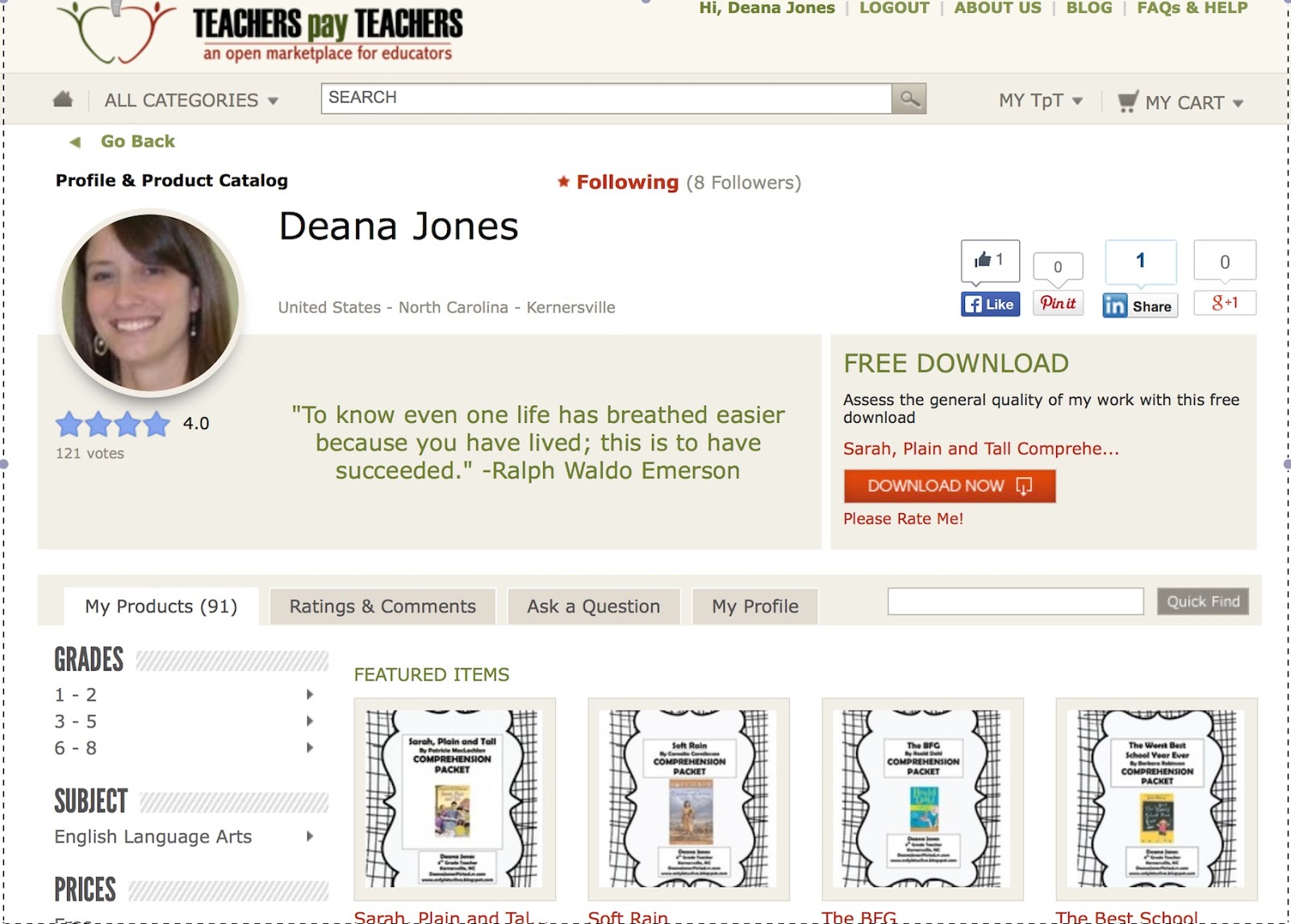
At the beginning of the school year, I went out on a limb and uploaded some novel units I’ve created to Teachers Pay Teachers (TPT), an ingenious website where teachers can sell and purchase digital products to and from each other.  Pretty soon, I had sold about $30 worth of products and I talked to Brent about whether or not I should pay the $60 fee to upgrade to a premium seller account so I’d get a higher percentage of profits.  He said sure, we spend more than that on dinner out at times, so why not? 

It seemed too good to be true that it could be this easy to make extra money off documents I already had created, but I hesitantly upgraded my account anyway.  Now Brent picks on me because I’ve earned that $60 back more than 25 times over.  I will admit I’ve put more and more time into formatting my novel units, creating more, and tinkering with the website, but my dorky teacher self really enjoys doing it.

If you are a teacher (public school, private school, or home school), here’s what you need to know/do:

1. Check out this website regularly.  There are about 150,000 free items available for download and close to a million items for sale.  (Check out my featured free item here.)  Most items are priced more reasonably than what you would pay from a publishing company.  Looking for resources on TPT has become part of my regular lesson planning routine, and my students have benefitted from the awesome resources I’ve found.  It’s saved me a ton of time and I’ve been able to strengthen my instruction affordably and creatively.

2.  Consider becoming a TPT seller.  You can upgrade to a seller account for free to see if there would be interest in your products.  I was so surprised when my products started selling; you never know what other people are looking for.  One teacher’s strength is another teacher’s weakness, and I look at TPT as an amazing new version of collaboration!  One more thing: If you are creating a new seller account, use my referral link.  I’ll be glad to help you get started, whether you use my referral link or not- just let me know! 

3.  Even if TPT doesn’t interest you, help out a friend.  If you have a TPT account, please consider visiting my store and “following” me.  Despite what I consider a pretty good start, I only have 8 followers currently and I’m one of them- ha.   Here’s the link to my TPT store.  If you’re already selling on TPT, let me know so I can follow you back!


I’m not much one for a sales pitch and if TPT hadn’t been the most exciting find of my teaching career, I wouldn’t waste your time.  Thanks for hearing me out and take it from a skeptic – this website IS worth all the hype!

Monday, January 20, 2014

Four Reasons to Read Divergent

A lot of people I know just read, are currently reading, or are about to read the Divergent series.  More than one friend recommended these books to me before Christmas, and I’ve doled out my share of recommendations since.  If you’re one of those people, beware: at the end of this post, I’m going to divulge the final four sentences at the end of the trilogy. But I promise I’m not the kind of person who would ruin the ending of a good book or a good movie. 

(Now, a bad movie on the other hand, I’d be glad to ruin.  For example, do not ever bother watching The Perfect Storm.  By the time it’s over, you’ll feel seasick and they’ll all be dead. I still haven’t gotten over the fact I endured that movie on the fourth row of the good ole K-ville theater when I was a teenager.)

On the contrary, I am counting the days until the Divergent movie comes out in March.  It’s been a long time since I’ve read a book as good as these.  I commented the other night that it might be my favorite book/series ever, and my middle school language arts teacher brother-in-law laughed at me, as if the latest teenage movie craze could not possibly be considered my favorite piece of literature.  Well, he was only 50 pages into the first book…I’m betting he’ll be changing his tune soon.   Move over Of Mice and Men; Mr. Elkins is about to have a new favorite book!

At first glance, it may seem that this series fits right in with the young adult fiction mania of the past several years: Twilight, Hunger Games, etc.  But for me, this series was more well-written, more enticing, more thought-provoking and just plain better than any of those.  So for that reason, I’d like to encourage you to read it with my short list entitled Four Reasons to Read Divergent.  And yes, I chose four reasons because one of the main characters is named Four. :)

1.  The factions are fascinating.
The books take place in a futuristic Chicago, where the people living there have been placed inside a fence and divided into five factions: Abnegation, Dauntless, Erudite, Candor and Amity.  Each faction has a strong suit that enables them to contribute positively to society (selflessness, bravery, intelligence, honesty, and peace) but also a converse weakness that contributes to their possible downfall.  As you are reading, you can’t help but think about which faction you’d find yourself in, which one you’d choose, and which ones you’d even be able to cut it in.  You’ll also think of others and where they would fit.  And you realize we all have our strengths and weaknesses, and many times they are inherent, so perhaps we should be a little more forgiving. 

2.  Tris is a terrific heroine.
One of my problems with the Hunger Games books was that Katniss drove me a little bit crazy.  Not that I would have done any better in her situation, but I still found her to be rather frustrating.  Tris, on the other hand, is much easier to relate to.  You’ll find yourself cheering for her, laughing with her, scared to death for her, and crying with her.  While she makes some questionable decisions at times, I could totally understand why she did what she did – every time.   And she’s a lot quicker to act than Katniss…these books move really fast!

3.  You won’t be able to put them down.
The books are written in first person and present tense.  Almost every chapter is a cliffhanger.  There is a lot of dialogue and since they are technically young adult novels, the spacing is generous.  While the books look thick, you’ll fly through them.  It’s been a long time since I’ve read a book that kept me up at night, but these did.   My husband started reading them the same time as me, and we tried to share my one set of hardcover books (a Christmas gift from my awesome sister).  Brent read the books so fast that I had a hard time staying ahead of him so he could have the next one when he was finished.  The teacher in me suggested we read the last one out loud to each other, but Brent laughed as if that was ridiculous.  It’s his loss – he’s still not finished with the third one and I am…I could have read it to him in my best teacher voice if he had taken me up on the offer! 

4.  You’ll remember why we’re here in the first place.
These books caused me to reflect not only on the state of our society, but also on my own life and what matters.  They reminded me that no matter what goes on around us, what counts is how we interact with and support the people around us.  There are love stories, familial relationships, and close friendships woven throughout the plot, even as unthinkable conflict is occurring.  Not so different than our own lives really.  The last four sentences of the third novel summed up so much of the way I’m trying to live my life these days.  It ends,  Since I was young, I have always known this: Life damages us, every one.  We can’t escape that damage.  But now, I am also learning this: We can be mended.  We mend each other.”

So true, and so worth the read!